

Why Sliding Table Saws Are Essential for Precision Woodworking

There’s a point many woodworkers reach where the type of work they want to do begins to exceed what a standard table saw is designed to handle efficiently. Panels need to be dead-square, crosscuts need to be repeatable, and larger sheet goods demand better support throughout the cut.
As projects grow in size and precision matters more, the limitations of a traditional table saw become more apparent—not as a fault of the operator, but as a function of the machine’s design. That’s often when woodworkers start looking for a tool built specifically to handle panels, long crosscuts, and consistent accuracy with less setup and repositioning.
A sliding table saw answers that need by supporting the material through the entire cut, making accuracy and repeatability part of the process rather than something that has to be worked around.
But the truth is, even the most talented hands can struggle when the tool isn’t built for precision. And that’s where a Sliding Table Saw steps in.
Once people use it, they usually wonder why they waited so long. Because suddenly cutting large panels doesn’t feel like a wrestling match, and accuracy doesn’t feel like a lucky moment, it becomes normal. So this blog walks you through everything in a simple, human way, not textbook-ish.
What Is a Sliding Table Saw?
A Sliding Table Saw is basically a table saw that decided it wanted to be smarter, smoother, and far more helpful than the regular ones. Instead of you pushing heavy wood across a flat table, the table itself slides the material for you. So the panel sits on a sliding carriage, you guide it gently, and the machine takes care of the steady motion.
This design is what makes it so popular in workshops where accuracy isn’t optional but part of the daily workflow. It’s a favorite among people handling furniture-making, cabinetry, millwork, and anything that involves cutting large sheets.
And because it’s part of the family of precision woodworking machines, it can handle detailed, repeated cuts without losing accuracy.
How Sliding Table Saws Work

The way they operate is actually pretty satisfying. You place the sheet on the sliding carriage. The rails underneath keep it balanced and smooth. Then, instead of pushing a huge panel toward a blade, which, let’s be honest, always feels a bit risky, you just glide the carriage forward.
-
No panel fighting gravity.
-
No arm fatigue during the cut from the weight of the sheet.
-
No awkward positioning or losing control halfway through the cut.
Inside, there’s a powerful motor, precision rails, fences for guiding angles, and a solid build that stays steady even when handling massive wood panels.
Key Features That Make Sliding Table Saws Unique
Sliding Carriage System
This is the star of the show. The carriage carries the material and does the movement for you. So the cut stays stable, smooth, and consistent from start to finish. Anyone who’s ever tried to manage a 4x8 panel (or larger) alone knows how big a relief this is.
Extended Rip Capacity
A regular table saw might limit you. A Sliding Table Saw doesn’t. Wide panels? Long boards? Large furniture components? It handles them easily. Great for shops building cabinets, built-ins, office furniture, or any work involving big panels.
Precision Cutting Mechanism
Sliding table saws don’t depend on how steady your hands are. The rails, fences, and mechanisms ensure straight lines and clean cuts every time.
Heavy-Duty Construction
These machines are not here to be delicate. They are rugged, solid, and built to handle long hours of cutting, varying thicknesses of boards, and frequent use. Because of this heavy-duty build, the machine doesn’t vibrate or shift, and that stability is a major reason it’s preferred in professional workshops.
Safety
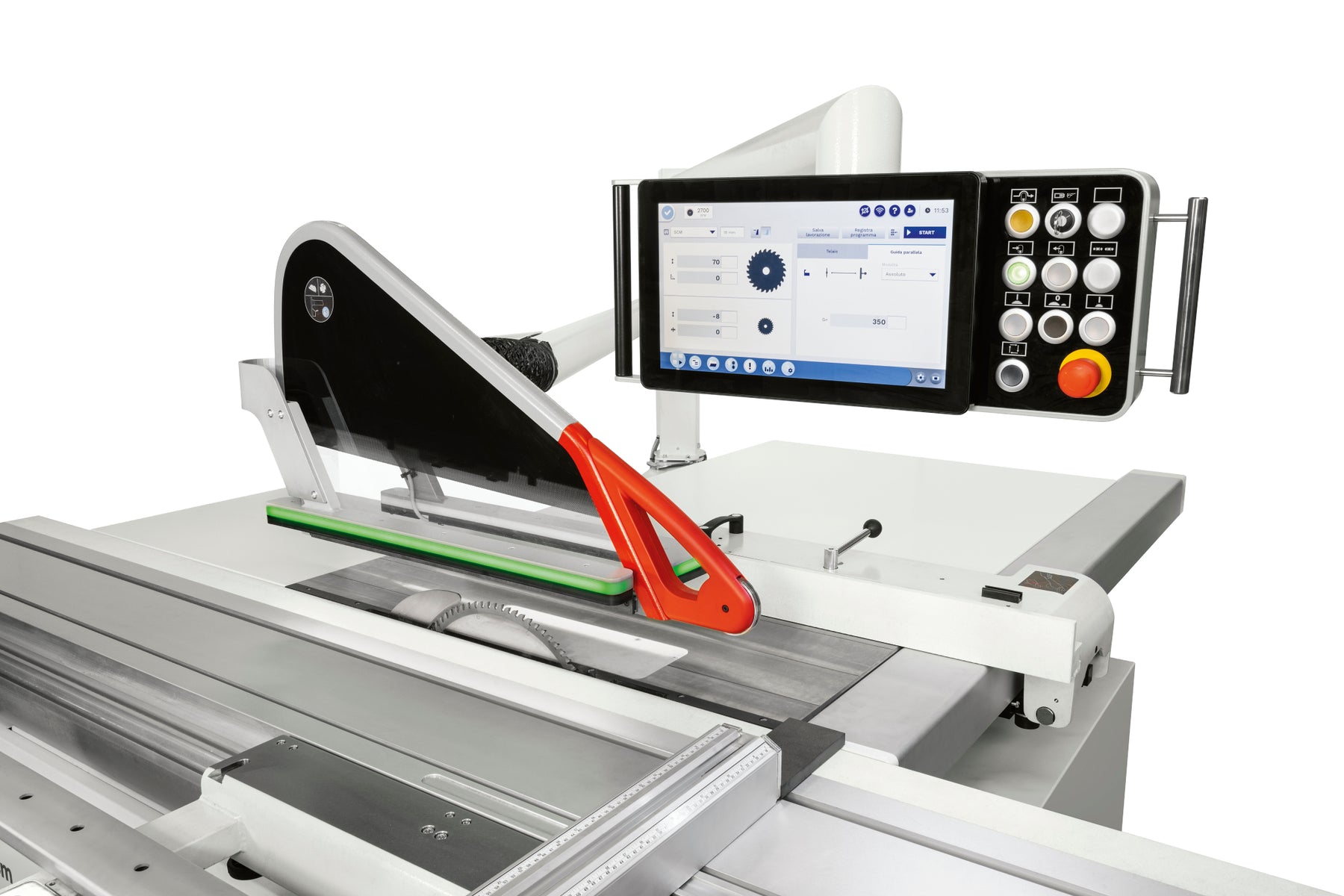
Safety is perhaps one of the most important advantages of a sliding table saw. Instead of pushing material across a stationary blade, the workpiece is secured on the sliding table and guided past the blade in a controlled, predictable motion. This keeps hands farther from the cutting area and reduces the need to reach, stretch, or apply side pressure during the cut.
Because the material is fully supported—especially with large panels—there’s less chance of tipping, binding, or kickback. The saw is doing the guiding, not the operator, which creates a more stable cutting process from start to finish. Fences, hold-downs, and clamps can be used effectively on the sliding table, further minimizing movement and improving control. In addition, there are technologies like the SCM Blade Off system, which prevents any accidental contact with the blade using smart sensors, recognizing the human body and triggering the system.to minimize risk.
For many woodworkers, the result is a calmer, more deliberate workflow. Cuts are made with better balance and visibility, and safety becomes an inherent part of the machine’s design rather than something that relies solely on technique or vigilance.
And here comes the real part, why woodworkers personally feel the difference when they switch to one.
1. Makes accuracy feel easy
Precision shouldn’t feel like a gamble. With sliding table saws, accuracy becomes the default. The sliding system holds the material steady and moves it smoothly, so the blade cuts exactly where you guide it.
2. Removes the fear of handling big panels
Cutting a large plywood sheet on a normal saw can be stressful. One misalignment and the cut is ruined. Sliding table saws turn that stressful job into a calm, controlled movement.
3. Reduces mistakes and wastage
Every wrong cut is money going to waste. Because these saws offer reliable, consistent cuts, you spend less time correcting mistakes and more time finishing projects.
4. Builds confidence
When you know your tool won’t fail you, your work becomes faster and more assured. Many woodworkers say this machine actually makes them enjoy the process more because they no longer fight with their tools.
Sliding Table Saw vs. Traditional Table Saw
|
Factor |
Traditional Table Saw |
Sliding Table Saw |
|
Handling of Large Panels |
Struggles with wide or heavy panels |
Handles large, wide panels with ease |
|
Safety |
Higher risk due to manual pushing |
Safer because the material stays secure on the sliding carriage |
|
Accuracy |
Depends heavily on steady hands |
Accuracy stays consistent due to the guided sliding system |
|
Physical Effort |
Requires more force and control |
Much less physical effort is needed |
How to Choose the Right Sliding Table Saw
Picking the right one isn’t hard if you know what matters.
-
Sliding table length: Longer tables mean easier handling of big sheets.
-
Motor power: A strong motor handles different material types without slowing down.
-
Build quality: Look for strong frames, smooth rails, and durable construction.
-
Space in your workshop: These are big machines. You need room to slide panels freely from multiple sides. Machine footprints are always available to help calculate needed floorspace.
-
Brand support: A good service network and parts availability matter a lot in the long run.
End Note
Woodworking is already a creative, hands-on craft, and the tools you use shouldn’t make it harder. A Sliding Table Saw takes away all the unnecessary struggle. And if you're planning to bring this level of accuracy into your workshop, it genuinely helps to pick a machine that’s built right and backed by solid support.
That’s where WSI Machinery steps in. If you’re looking for reliable sliding table saws, heavy-duty woodworking machinery, or expert guidance on choosing the right machine for your workflow, WSI Machinery is a great choice for helping you get the saw that best fits your needs.
We offer trusted machines, smooth assistance, and support that actually understands what modern workshops need.

Leave a comment